SEO and Web Design: Why They Should Go Hand in Hand
Key Takeaways
- SEO and web design should be planned together, because layout, content, speed and navigation all affect search performance.
- A beautiful website is not enough if customers cannot find it or understand what the business offers.
- Mobile performance matters in Singapore, where internet usage and smartphone adoption are already extremely high.
- SEO planning should happen before development, especially when deciding the sitemap, page hierarchy and content requirements.
- Redesigning without an SEO migration plan can cause rankings, traffic and valuable pages to disappear.
SEO and web design should be developed together because SEO brings relevant visitors to a website, while good design helps those visitors understand, trust and contact the business.
A website can look atas, load with fancy animations and win compliments from the management team. But if it sits on page five of Google, then hardly anyone is going to see it.
When one is handled without the other, companies often end up paying twice: once to build the website and again to repair its search visibility, content or conversion problems.
So today, we like to shed some light on how the best web design company in Singapore combines both SEO and web design together, the best of both worlds.
How Are SEO and Web Design Connected?
SEO helps people find a website while web design affects what they do after reaching it. Again, SEO covers much more than adding keywords. It also involves:
- Website architecture
- Page content
- Internal links
- Mobile usability
- Loading performance
- Crawlability
- Indexing
- Structured data
- Search intent
Web design determines how these elements appear and function.
For example: an SEO specialist may recommend a detailed service page targeting “commercial interior design Singapore”. However, if the approved template only provides space for one headline, three icons and a contact button, the page may struggle to explain the service properly.
The opposite can also happen. A designer may create a gorgeous website, but Google cannot easily crawl its links, understand its content or identify which pages should rank.
Why Does This Matter for Singapore Businesses?
DataReportal estimated that Singapore had 5.78 million internet users at the end of 2025, representing an internet penetration rate of approximately 98.4%.
Singapore’s digital economy also reached S$128.1 billion in 2024, equivalent to 18.6% of GDP, according to IMDA’s Singapore Digital Economy Report 2025.
Which means more than two-thirds of that digital economy came from industries outside the information and communications sector.
A potential customer might:
- Search for a service on Google.
- Open three or four websites.
- Compare prices, experience and reviews.
- Check whether the site feels trustworthy.
- Leave if the page is slow or confusing.
In such cases, if the visitor must hunt for the service description, pinch the screen or wait for a giant video to load, the competitor’s tab is already open.
Why Should SEO Start Before Web Design?
SEO research helps decide what the website should contain before anyone starts designing page layouts.
The process should begin with questions such as:
- What services are people searching for?
- Which searches show buying intent?
- What pages are already performing?
- Which service deserves its own page?
- How should related pages be grouped?
- What questions do customers ask before enquiring?
- Which page should target each keyword topic?
These decisions affect the sitemap which is basically a directory within a website.
Let’s say a company offers accounting, payroll, tax filing and company incorporation.
Putting everything into one short “Our Services” page may look neat, but it creates several problems.
Google receives limited information about each service. Visitors must scan through unrelated information. The company also loses the opportunity to rank individual pages for searches such as:
- Payroll outsourcing Singapore
- Corporate tax services Singapore
- Company incorporation services
- Small business accounting services
Keyword research might show that separate pages are needed and that finding should shape the design brief from day one.
How Does Website Architecture Affect SEO?
Website architecture helps search engines and visitors understand how pages are connected.
A simple hierarchy could look like this:
Home → Services → SEO Services → Local SEO
This is clearer than placing every page directly under the homepage or hiding important pages inside a complicated dropdown.
Good architecture should allow important pages to be reached within a few logical clicks. It should also use descriptive navigation labels.
“SEO Services” is clearer than “Solutions”.
“Web Design Portfolio” is clearer than “Discover”.
“Contact Us” is clearer than “Let’s Connect”.
Creative wording is fine in the main copy, but navigation should be simple.
What a website Hierarchy might look like
A service business might use:
- Home
- Services
- SEO
- Web Design
- Google Ads
- Industries
- Healthcare
- Professional Services
- Retail
- Case Studies
- Insights
- About
- Contact
This allows service pages, industry pages and supporting articles to link naturally to one another.
Website Speed and Core Web Vitals Matter Too
Heavy design elements can make a website look impressive while making it unpleasant to use. That’s because the more stuff on a site, the longer it takes for a website to load the page.
“Google found that 53% of mobile visitors leave when a page takes longer than three seconds to load”
Google’s Core Web Vitals measure three main aspects of user experience:
- Loading performance
- Interactivity
- Visual stability
Google recommends achieving good Core Web Vitals for search success and general user experience, although strong scores alone do not guarantee high rankings.
Common causes of slow websites include:
- Uncompressed hero images
- Autoplay background videos
- Too many font files
- Excessive plugins
- Unused JavaScript
- Third-party chat tools
- Large sliders
- Poor hosting
- Animation on almost every section
Can Good Web Design Improve SEO Conversions?
Yes. Rankings bring traffic, but design helps turn that traffic into enquiries or sales.
A visitor should be able to answer four questions quickly when they land on your website:
- Am I on the right page?
- Does this company provide what I need?
- Can I trust it?
- What should I do next?
The design should make those answers visible.
Useful trust elements include:
- Client testimonials
- Case studies
- Certifications
- Team credentials
- Recognisable clients
- Clear business details
- Service processes
- Transparent pricing guidance
- Relevant guarantees
Do not hide all the proof inside one carousel near the bottom of the homepage. Place evidence near the claims it supports.
For example, if the page says the company improved organic traffic, show a related figure or case study nearby.
Rule: Do not make visitors work harder than necessary to verify a claim.
Every page does not need five flashing buttons, one clear next step is often enough.
How Should SEO and Web Design Teams Work Together?
SEO specialists, writers, designers and developers should collaborate from planning to launch.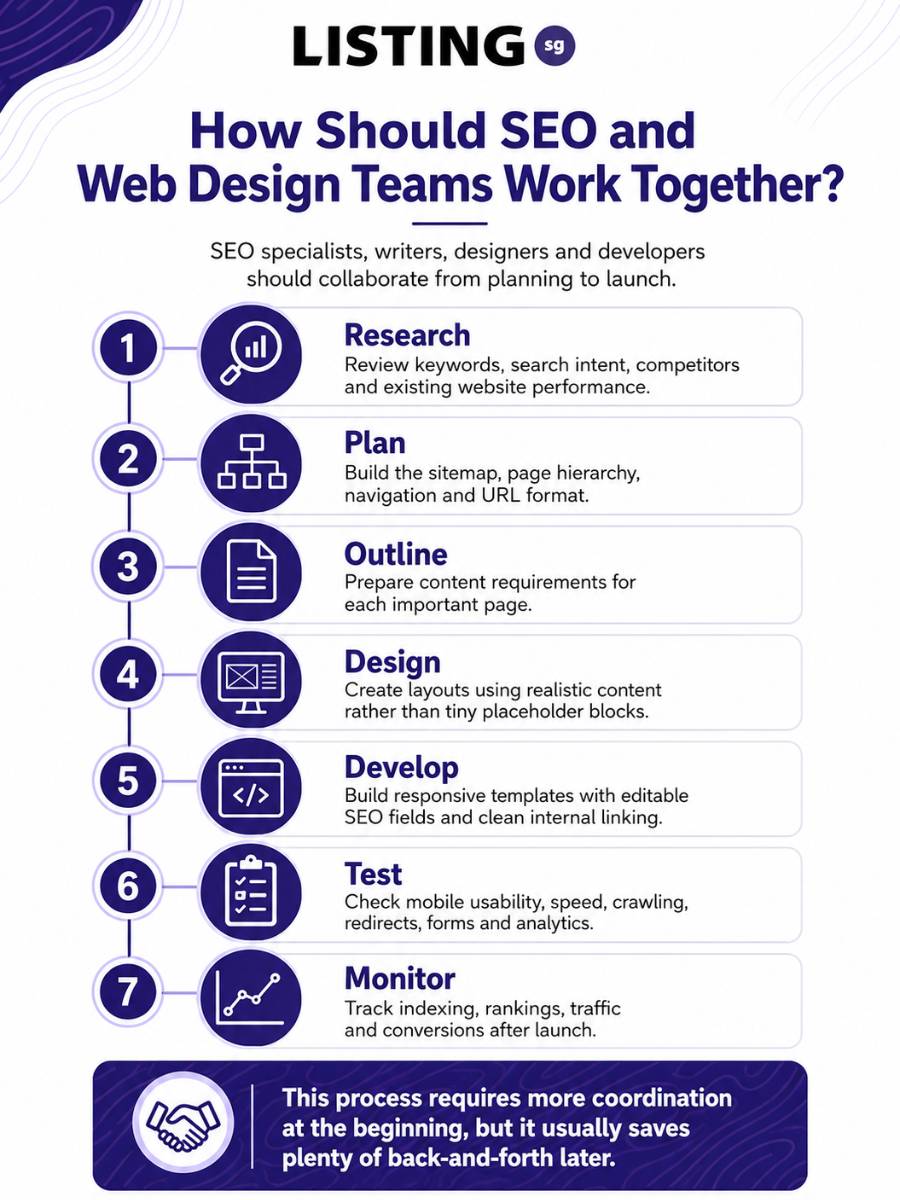
SEO and Web Design Should Support the Same Goal
SEO and web design are not competing priorities. One helps a website get discovered; the other helps visitors feel comfortable taking action.
When both are planned together, the website becomes easier to find, faster to use and clearer to understand.
If you’re looking for the web design companies that master both practicality and style, why not head to Singapore best business directory! Browse suitable options, review their services and find a team that understands both website performance and search visibility!
Frequently Asked Questions About SEO and Web Design
What Is SEO Web Design?
SEO web design means creating a website that is easy for search engines to crawl and useful for visitors. It combines content, architecture, mobile usability, speed and conversion-focused design.
Why Should SEO Be Included in Web Design?
SEO helps determine which pages are needed, how they should be organised and what content they require. Starting early reduces costly changes after the website is built.
How Does Web Design Affect SEO?
Web design affects loading speed, mobile usability, navigation, content readability and internal links. Poor design choices can make pages harder for visitors and search engines to understand.
Do Attractive Websites Automatically Rank Well?
No. A visually attractive website still needs relevant content, crawlable pages, technical optimisation and authority. Design alone does not prove that a page satisfies search intent.
How Can I Make My Website More SEO-Friendly?
Use responsive design, clear navigation, descriptive headings, compressed images and useful content. Important pages should load quickly and be accessible through normal internal links.
Are SEO and Web Design Separate Services?
They are different disciplines, but they should be coordinated. SEO, content, design and development decisions frequently affect one another throughout a website project.